

Tucked away in the heart of Madhya Pradesh, Satpura Tiger Reserve is one of India’s best-kept secrets. Unlike the well-frequented safari circuits of Ranthambhore, Bandhavgarh, and Jim Corbett, Satpura offers a quieter, more intimate experience of the wild that isn’t found in your average wildlife handbook.
While tigers do roam these teak and sal forests and leopards slip silently through the ravines, Satpura’s true charm lies in some of its inhabitants that are lesser-known, overlooked, yet quietly extraordinary. Satpura is home to 52 species of mammals, 300 species of birds, 123 species of butterflies and 31 species of reptiles.
From rare mammals like the Indian giant squirrel and leaf-nosed bat, to the successful reintroduction of the hardground swamp deer in Central India, Satpura is a living library of evolutionary marvels. This blog chronicles some of the lesser-known wildlife of Satpura.
The Rare Leucistic Gaur | Wildlife of Satpura
One of Satpura’s most intriguing sightings is the rare leucistic form of the Indian Gaur. Unlike albino animals, leucistic individuals have reduced pigmentation but retain normal eye colour. What’s fascinating is how this genetic anomaly has persisted in a small population.
The pale version of the Indian gaur has been occasionally spotted in herds around the Madhai range, and while they are not a separate species, their rarity and striking white appearance have made them legendary among forest guides and naturalists. For wildlife photographers and enthusiasts, glimpsing a leucistic gaur is akin to winning a jackpot in the wild.

The Return of the Swamp Deer (Barasingha)
In a landmark conservation effort, Satpura became home to one of India’s most endangered deer species – the hard ground swamp deer, or barasingha(Cervus duvauceli branderi). Originally endemic to Kanha National Park, this species inhabited areas stretching up to Satpura National Park in the 1920s, after which it disappeared due to habitat loss and poaching.
Limiting the entire population of this endangered species to a single location was considered risky, even though this species was successfully brought back from the brink of extinction. Between March 2015 and 2023, 98 barasinghas were carefully translocated from Kanha to a specially prepared enclosure in the Bori range of Satpura Tiger Reserve. Today, the reintroduced population has grown to over 178 individuals, with a second enclosure in Matkuli, a rare success in wildlife rewilding in India.
Their presence has added a new ecological layer to Satpura and provides visitors with the rare chance to witness this species outside of Kanha.
Also Read: Best Zones in Satpura

Jungle Fowl – In Technicolor and in Stereo
Satpura is one of the few places in India where you can spot both the grey junglefowl (Gallus sonneratii) and red junglefowl (Gallus gallus) living in the same ecosystem. These wild ancestors of domestic chickens are known for their striking plumage and raucous calls, similar to that of roosters, that echo through the sal and teak forests.
The red junglefowl, with its glossy black and orange feathers, is native to the lower Himalayas and the eastern parts of India. The grey junglefowl, endemic to peninsular India, sports a subtler palette but an equally dramatic demeanor. Their overlapping ranges in Satpura make the forest a treat for birders. In recent years, the grey junglefowl seems to have become the dominant species and is spotted more frequently than its red counterpart in areas such as Jhin Jhini Mehel and Chutki Dev.
The Indian Giant Squirrel – Satpura Tiger Reserve’s Mascot
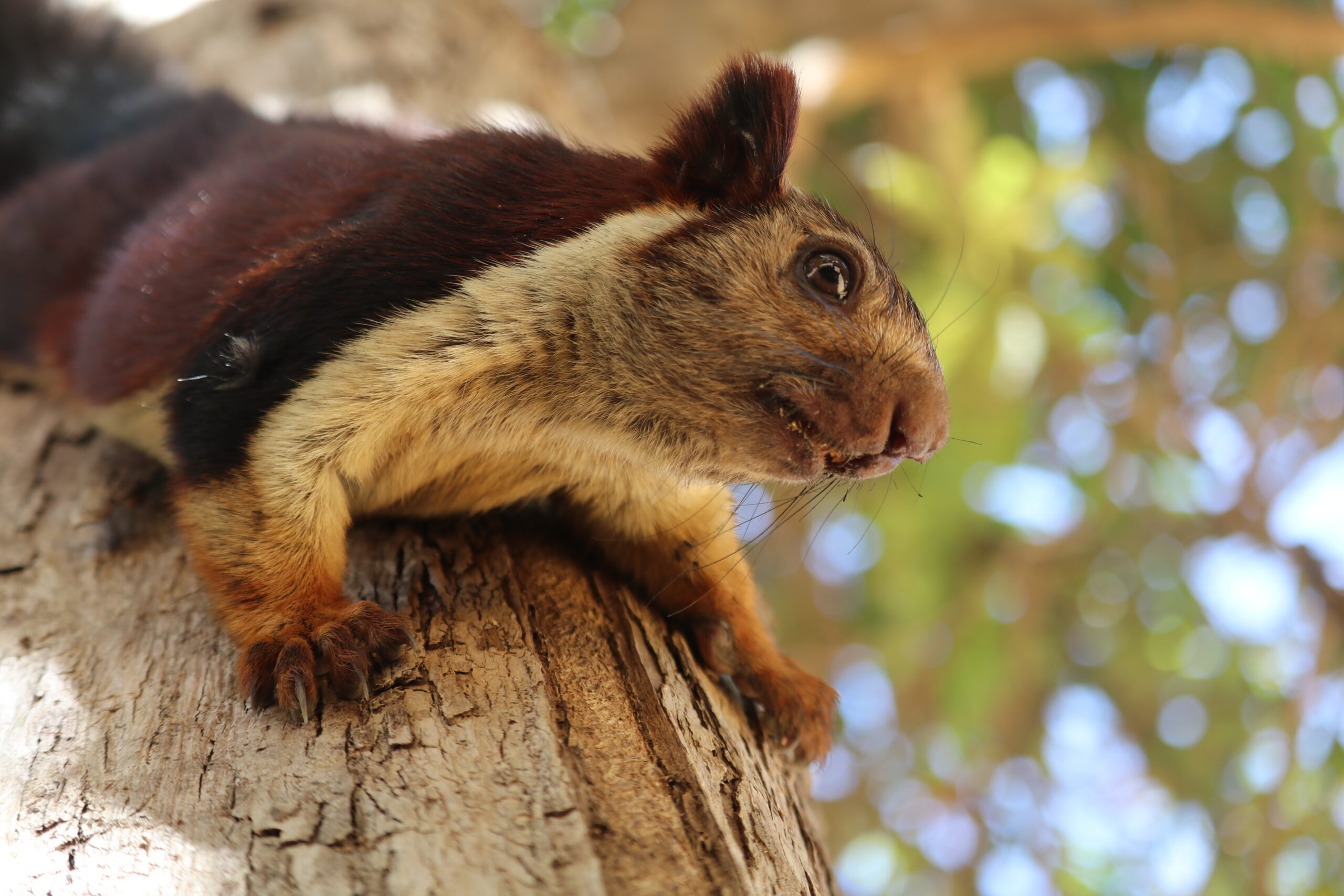
The Indian Giant Squirrel (Ratufa indica centralis), a large, tree-dwelling rodent with a dramatic coat in shades of rich maroon, black and cream, is often spotted leaping between branches or feeding on fruit high in the canopy. Unlike most squirrels, this species is diurnal and prefers tall, mature forests – perfectly matched to Satpura’s terrain.
One of the most charismatic small mammals endemic to the region, it has been adopted by Satpura Tiger Reserve as the official mascot – a playful Malabar giant squirrel named Nanhi. Its geographic distribution extends to the Satpura-Kanha corridor and Phen Wildlife Sanctuary.
Otters: Forest River Royalty
Satpura’s rivers, particularly the Sonbhadra and Denwa, are home to two of three species of otters found in India – Eurasian otters (Lutra lutra) and smooth-coated otters (Lutra perspicillata). These sleek aquatic mammals are indicators of clean water and healthy aquatic ecosystems.

Within India, the Eurasian otter was first recorded in Satpura. It is more elusive, usually seen alone or in small groups. The smooth-coated otter, on the other hand, is social and playful, sometimes observed rolling in the mud or gliding through the river in synchronized motion.
Boat safaris in Satpura are among the few wildlife experiences in India where one might witness otters in the wild, although they can also be seen in other parks like Kanha, Panna, and Sanjay Dubri Tiger Reserves.
Greater Horseshoe Bat and Leaf-Nosed Bat in Central India
Satpura Tiger Reserve holds the distinction of being the only location in Central India where the greater horseshoe bat has been recorded. These bats are named for the horseshoe-shaped fold of skin on their noses, used to emit echolocation calls.
Meanwhile, the leaf-nosed bat, recorded in Satpura, is a fascinating cave-dweller known for the distinct leaf-like structure on its nose, which aids in echolocation. While not exclusive to Satpura, its presence here highlights the reserve’s rich diversity of microhabitats, from dense forests to rocky crevices and hidden caves. They are a sign of a healthy and undisturbed subterranean ecosystem.

Avian Abundance: Raptors, Migrants, and Forest Songbirds
Beyond the junglefowl, Satpura is a haven for over 300 species of birds, both migratory and resident. The Tawa reservoir serves as a significant habitat for avian species. In winter, the backwaters attract bar-headed geese, ruddy shelducks, brahmi ducks and cormorants, while raptors like crested serpent eagles, changeable hawk-eagles, and white-eyed buzzards circle overhead.
Among forest birds, Satpura is rich in woodpeckers, leafbirds, minivets, and drongos, while the dawn chorus is dominated by Indian pittas and Malabar whistling thrushes. It is also home to the paradise flycatcher – the state bird of Madhya Pradesh.
Birders visiting Satpura often report surprise sightings, like Indian skimmers near the Denwa river or Indian vultures roosting in rocky cliffs, thanks to the park’s diverse terrain and microclimates.
Also Read: The History and Legacy of Satpura Tiger Reserve
Hidden Gems: Leopard Geckos and Endemic Butterflies
Some of its Satpura’s wonders are tiny and elusive. Take the Satpura leopard gecko, for instance – a rare and striking species named after the very mountain range it calls home. First described from the Pachmarhi plateau, this gecko is known for its beautifully patterned skin and nocturnal habits. Its geographical range spans the larger Satpura hills, extending into protected areas like Bandhavgarh, Melghat, and parts of the Vidarbha region, underscoring how this landscape connects multiple biodiversity zones.

The hills are also a haven for butterfly enthusiasts. Satpura boasts over 123 recorded butterfly species, including the Pachmarhi bush brown butterfly, which is endemic to this region. Their presence is an indicator of healthy undergrowth, native plants, and unfragmented forest ecosystems. The Panarpani nursery and butterfly garden in the area is known for butterfly activity and is operated by the forest department.
Why This Matters: A Biodiversity Time Capsule
Satpura is not simply another tiger reserve. It’s a biodiversity time capsule, a landscape where Gondwana-era rocks meet modern conservation science. Its forests are old and ecologically complex, home to numerous unique species.
Visiting Satpura is about encountering a forest that’s alive in unexpected ways – from the flap of a giant squirrel’s leap, to a wet trail left by otters on a sandbank.
This is a place for the curious, the patient, and the keen-eyed. A place where every rustle is a clue and every trail leads to a story few others have heard.
Also Read: Things To Do in Satpura National Park
Planning a Visit?
The best time to visit Satpura for wildlife experiences is October to March, when temperatures are pleasant and sightings are rich. For those interested in birds, butterflies, and river life, December to February is ideal. Choose between walking safaris, kayaking, and boat rides to access different layers of the ecosystem beyond jeep safaris, all the way up to June end, before core zones shut for the monsoon.
Satpura promises a different kind of wilderness, one where nature still holds its secrets close. If you’re looking for resorts in Satpura that blend comfort with conservation, plan your trip with a trusted safari partner like Pugdundee Safaris, and come home to eco-luxury by the banks of the river at Denwa Backwater Escape. Let Satpura surprise you. Its stories are quieter, but no less wild.